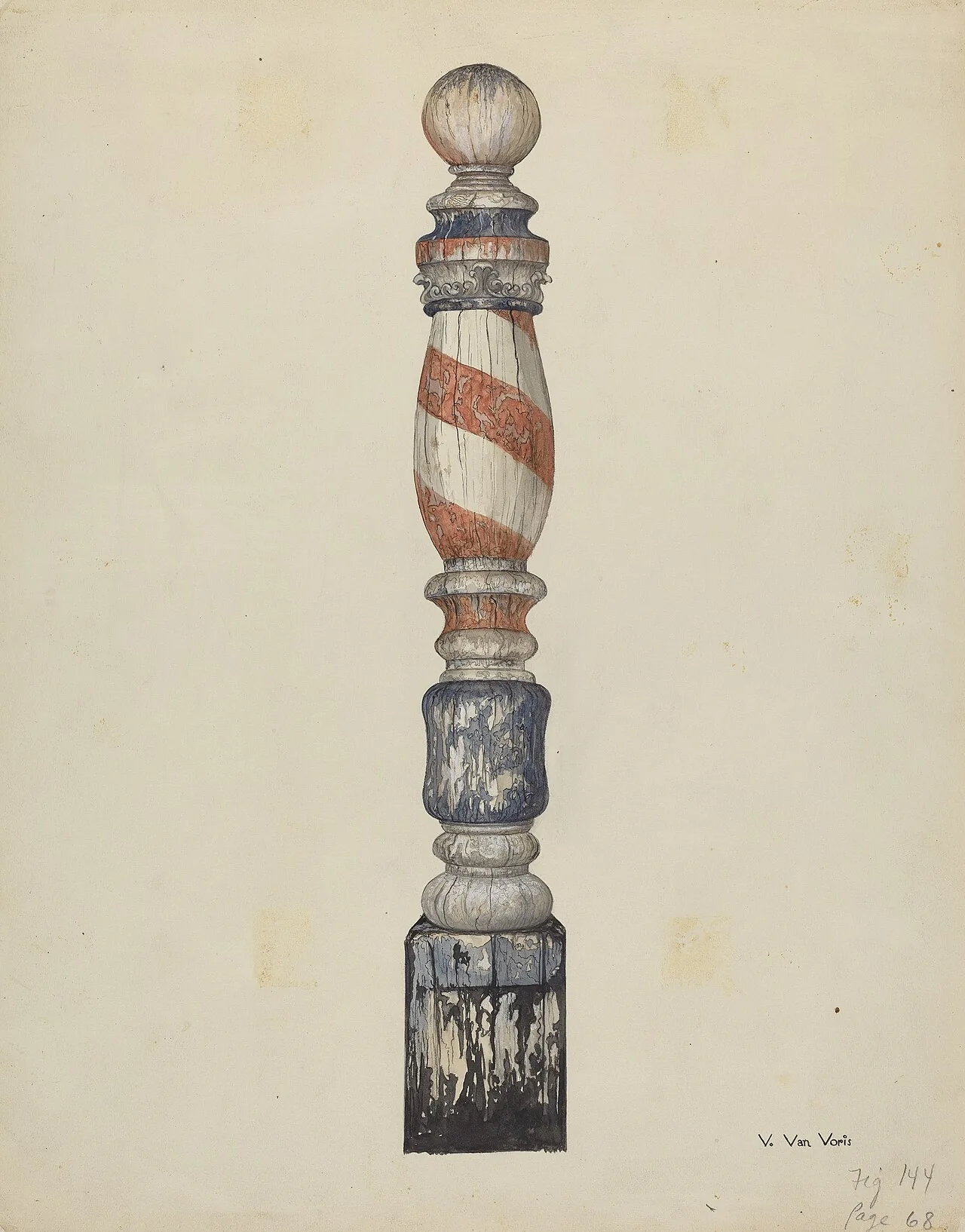
I started noticing barber poles around Belgrade relatively recently. They were never a familiar part of the local hair salon landscape when I was growing up. Now the red, white and blue cylinder is easy to recognize. You do not need the name of the shop to understand what it means.
What I did not know until recently was why it means barber in the first place.
For centuries, barbering and surgery were closely connected. Barber-surgeons cut hair and shaved faces, but also pulled teeth, treated wounds, and performed bloodletting. In London, the two trades were joined in the same company from 1540 until 1745, although their roles were distinct.
The traditional explanation for the red and white pole comes from that practice: red for blood, white for bandages, and the pole itself associated with the staff a patient held during bloodletting.
Exactly when the striped pole first became a trade sign is uncertain.
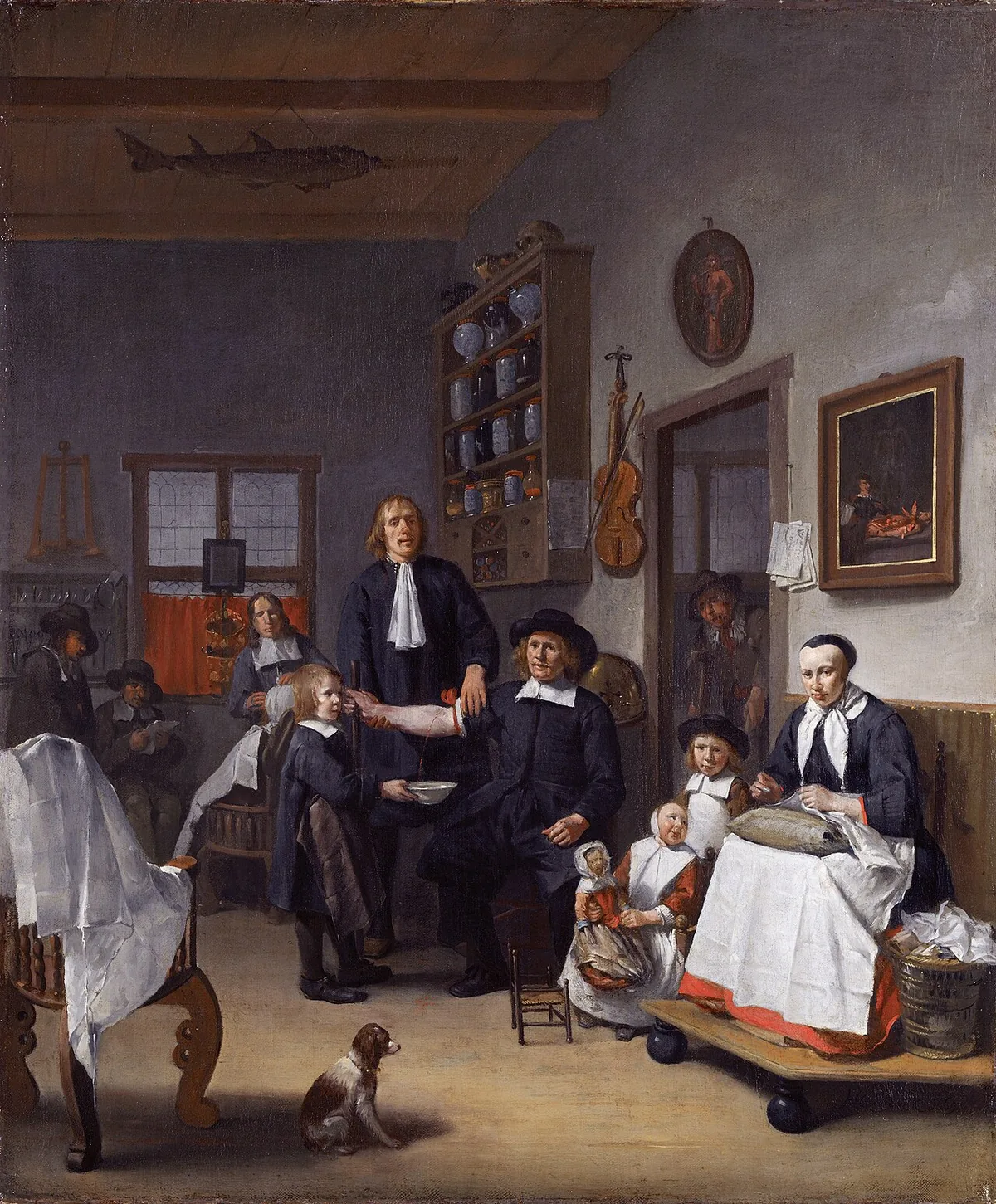
_and_family_in_his_barber-surgeon_shop,_by_Egbert_van_Heemskerck_(ca_1634_-_1704).jpg)
Red and white are the traditional colors. By the 19th century, some poles also included blue, particularly in America.
That makes the version I filmed in Belgrade more interesting to me. It is not an old local trade sign I remember from growing up. It is a visual code that arrived already carrying its meaning.
A category sign
As barbering and surgery became separate professions, the pole remained with barbers.
You do not need to know anything about barber-surgeons to recognize one today. You simply know that it means barber.
From a branding point of view, that is the interesting part. It identifies a trade rather than a particular business. The proportions, colors and construction vary, but a surprisingly small number of cues are enough to identify the category: a cylinder, diagonal stripes, usually red and white, often blue, and frequently rotation.
The movement matters too. The rotating stripes create an optical effect that makes them appear to travel along the pole, which is difficult to miss on a street full of static signs.
From somewhere else to here
I cannot say exactly when barber poles started becoming common in Serbia, or who brought them here. My impression is simply that I see many more of them now than I did twenty years ago, alongside the newer barbershop culture that has appeared in Belgrade.
Serbia did not need the history behind the barber pole in order to adopt its meaning. By the time I started seeing the sign here, the connection between the stripes and the barber was already part of an international visual language.
What interests me is that I could read the sign before I knew its history. The stripes already meant barber; the explanation came later.
You can remove the surgery, the bloodletting and several centuries of context, and the sign still tells you where to get a haircut.