I never trained in a club, although I probably should have. I learned by playing, first on a table in the hallway directly outside my elementary-school classroom, then wherever I could find a decent opponent. That was enough to make me a little too serious for casual ping-pong, but never a trained table-tennis player.
The game has also found its way into my work more than once. In 2015, I designed the identity for StoniTenis.org, a Serbian table-tennis portal. Much later it returned from a completely different direction.

I had been following Petar Ačanski’s work for some time, and when he started showing Swomp, his new typeface, I wanted to make something with it. I liked the typeface, but also the range and curiosity behind his work. Petar moves comfortably between UX/UI, graphic design, type, motion and 3D, and has the slightly inconvenient habit of taking each new interest seriously enough to become very good at it.
Making something with Swomp felt like a nice way to support that work.
It just took me almost a year to finish it.
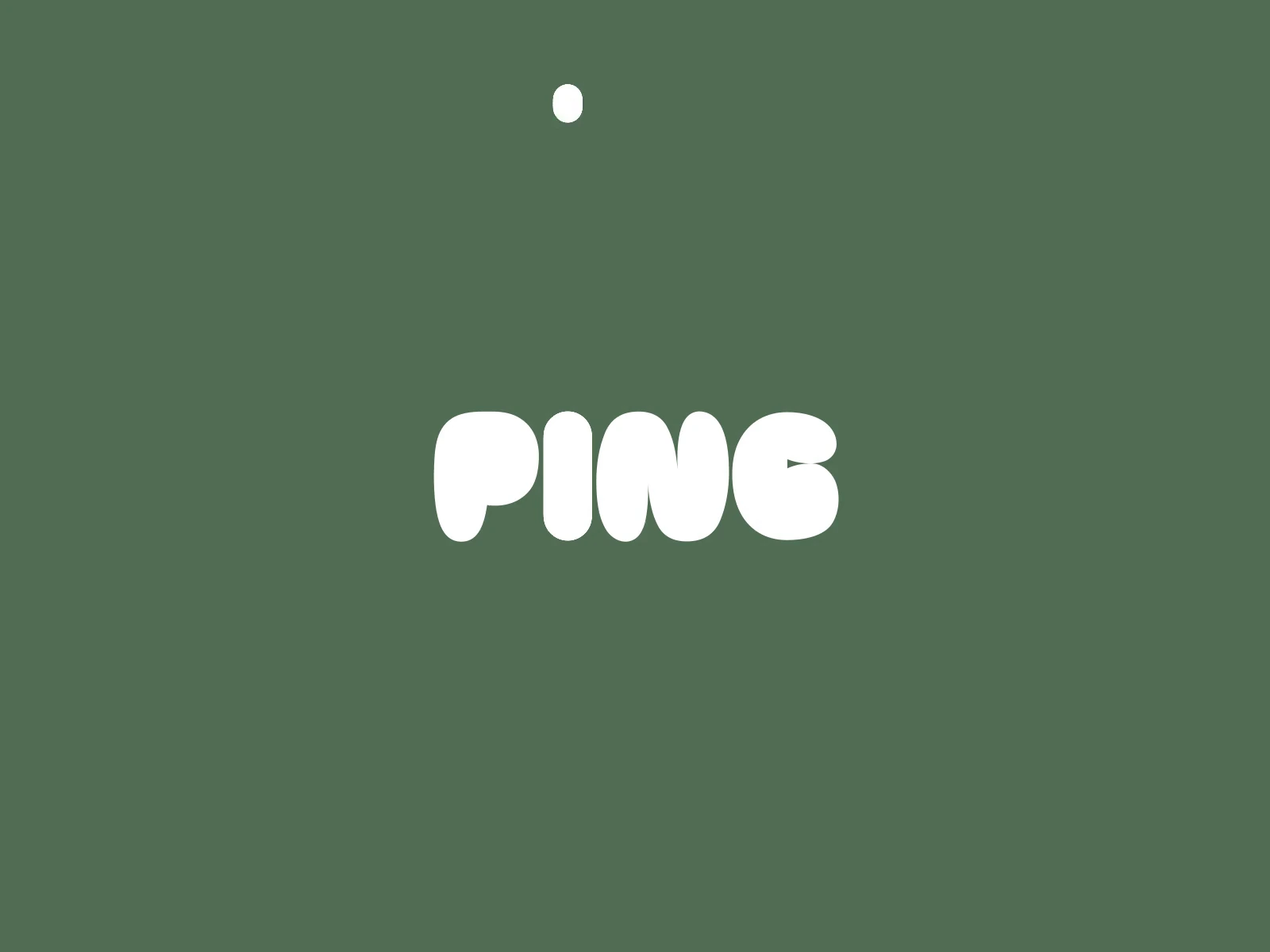
What began as a small type experiment gradually became a looping game between PING and PONG, followed by far too much time spent adjusting the behavior of one small white ball.
That probably makes more sense if I go back to the school hallway.
The table stood almost directly in front of my classroom. As soon as a lesson ended, we were there, even when there was barely enough time to get a game going before the bell sent us back inside. Our PE teacher was a decent player himself and played with us often enough that table tennis became more than something to fill ten minutes between classes.
There was also a local club, and quite a few kids joined it. I did not. At the time I remember thinking mostly about school, grades and the commitment of training regularly. It did not feel like a major decision. I simply never went, and looking back I wish I had.
Not because I imagine there was a professional career hiding somewhere on the other side of that decision. What I regret is much more ordinary: I never learned the game properly.
I never had the repetitions, technical corrections and deeper understanding that come from training. Whatever I learned, I learned by playing. Over time that was enough to make me better than many occasional players, but not enough to make me a trained one, which leaves me in a slightly awkward recreational middle.
It can also make finding opponents surprisingly difficult. People who play once or twice a year tend to lose, and they are not always enthusiastic about arranging the next match. It probably does not help that I occasionally tell weaker opponents that we are not playing badminton and that table tennis should be a little faster and lower than an exchange of long floating shots.
I realize this may be part of the problem.
When I was learning, we played to 21 points, with the service changing every five. The official game moved to 11 points in 2001, with service changing every two, but that change never really settled into my recreational version of the sport. Even now, 21 still feels normal to me.
The names have always seemed to contain a similar distinction. Table tennis is the organized sport: clubs, training, competition, technique, equipment and rules. Ping-pong is what happens in school hallways, garages, basements, offices and anywhere else somebody manages to fit a table.
Historically, the distinction is not that neat. Ping-Pong became a protected commercial name early in the development of the game, while table tennis became the institutional name used by governing organizations. The older name never disappeared from everyday speech and was later revived in separate competitive formats.
For me, though, the distinction is mostly personal. Table tennis is the organized sport I never properly entered; ping-pong is the game I never really left. I have spent most of my life somewhere between the two, never trained but usually taking it slightly too seriously.
Doubles are probably my favorite version of that middle ground. When the four players are reasonably balanced, the game becomes wonderfully chaotic: make the shot, move out of your partner’s way, recover position and somehow be ready again before the rally comes back around.
My own strengths have always been spin and, especially, the return. Khm, khm, Djokovic.
Penhold players were usually the opposite side of that equation. Their serves and slices could produce spin and angles that I understood approximately half a second too late, which is often enough.
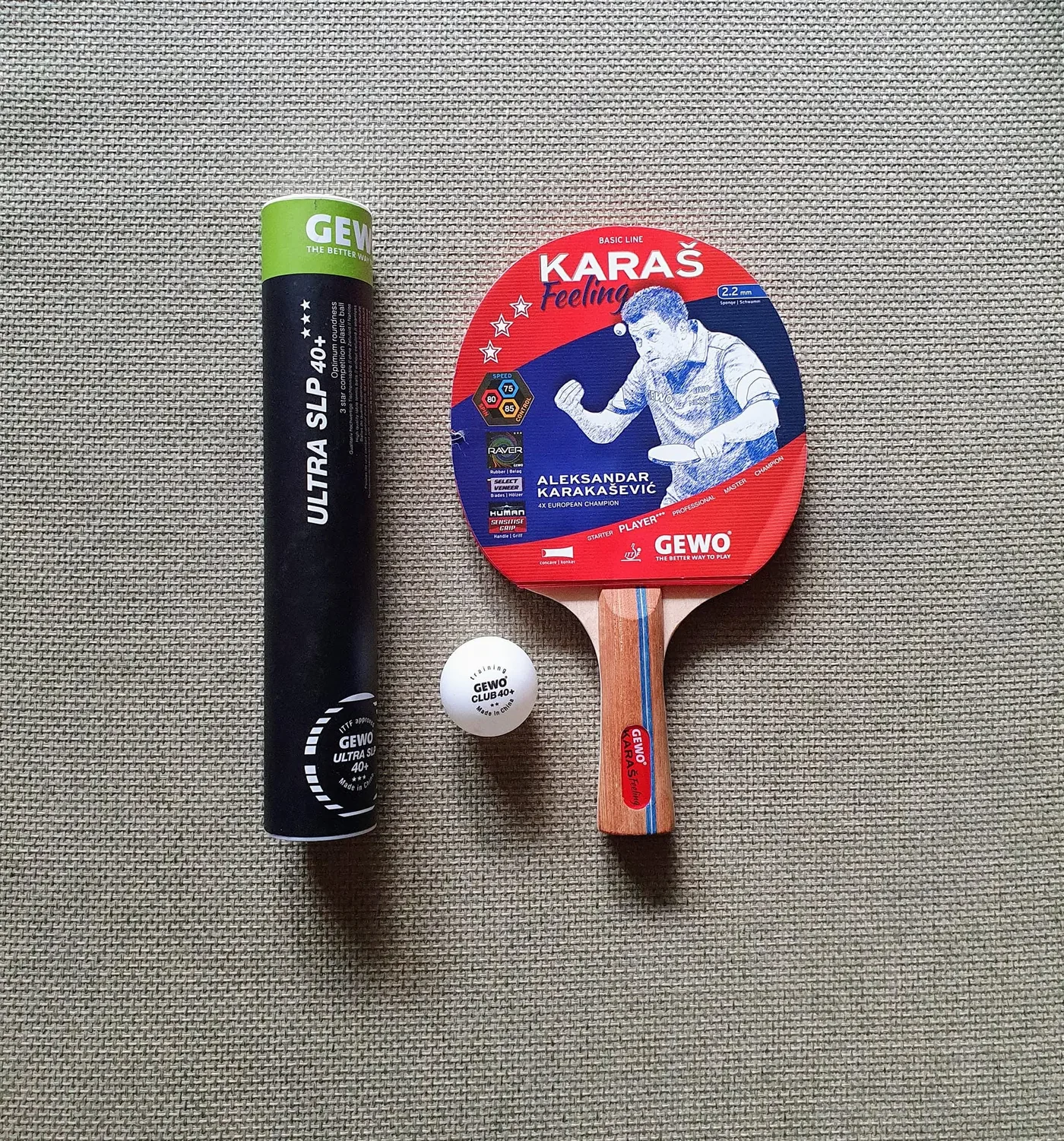
My equipment tells roughly the same story. I have never been the person comparing rubbers, selecting blades and building a racket around a carefully defined style of play. People who trained usually know exactly what they want from those choices. I went with a Karakašević set, a little above completely casual equipment.
I bought a set.
Finding someone to play with regularly has been more complicated. There is a fairly small overlap between people who enjoy table tennis, play at roughly the right level and happen to be available. That is what made Eleven Table Tennis, a VR version of the game, interesting to me in the first place.
So I bought a headset.
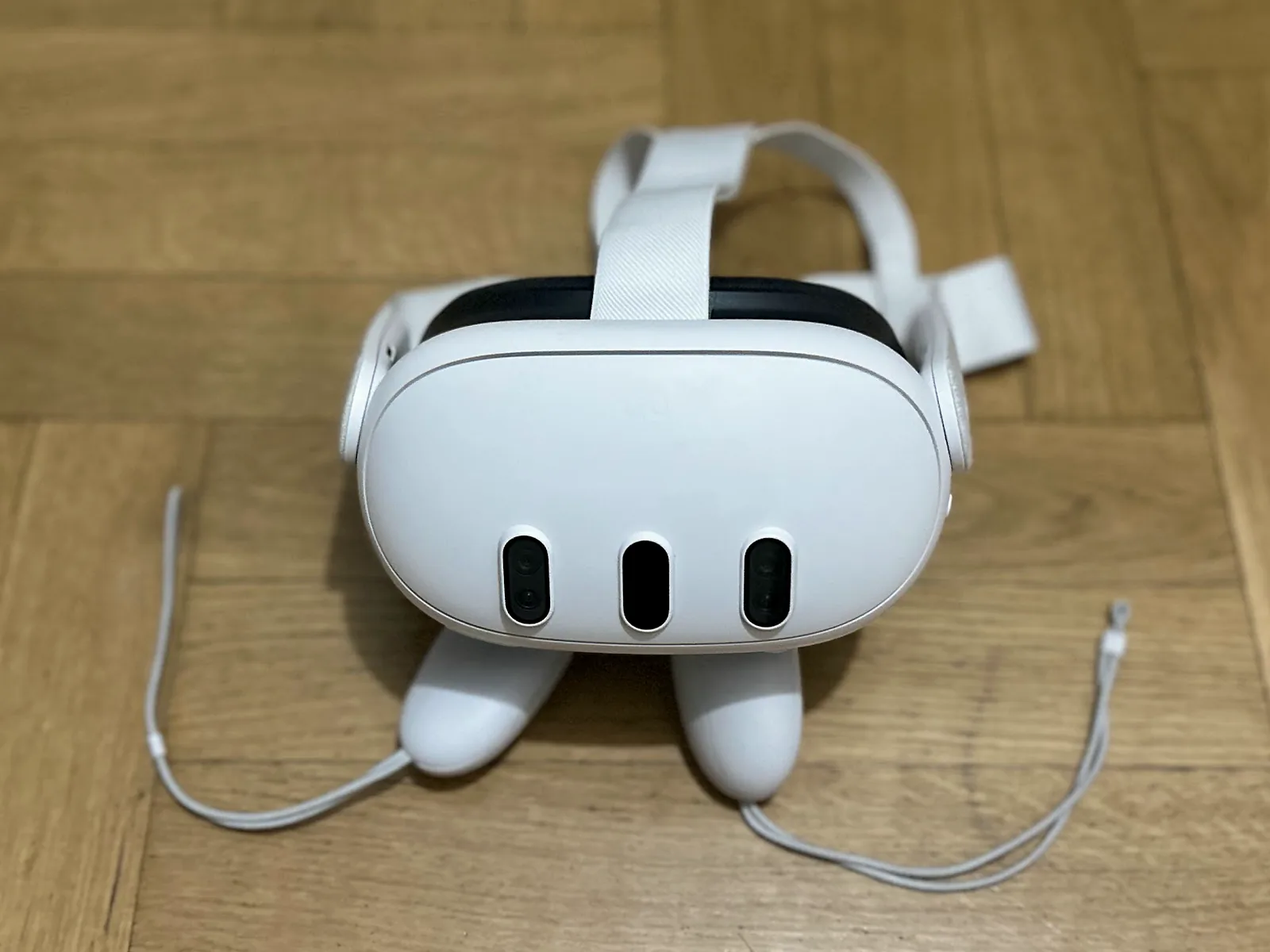
I’m now experimenting with it on a Quest 3, seeing how much of the timing, spin and feel carries over. Whether it becomes a regular substitute for a real table is something I’m still figuring out.
The Swomp experiment sits somewhere inside this longer relationship with the game. I wanted to make something with Petar’s typeface, started playing with the forms and ended up with a motion piece that gradually became much less small than intended.
The difficult part was not finding a way to explain the animation. It is there to be seen. The problem was getting it to feel convincing while still working as a type specimen.
At the edges of the frame, the ball needs to bounce naturally. Around the letters, physics can bend a little because the typographic idea needs enough time to register. The surrounding forms can react, but not so much that they become noise, and the spacing still needs to work throughout because underneath the bouncing ball and the visual joke, the point is still to show a typeface.
The rule I eventually arrived at was simple enough: real physics at the edges, designed physics inside the letters, stable optical kerning throughout.
I probably spent more time refining those few seconds than anyone watching them will ever notice. That is not particularly unusual in design. A lot of the work sits in adjustments that are only obvious when they are wrong.
The experiment started because I wanted to make something with a friend’s typeface. By the time I finished it, it had connected a school hallway, a club I never joined, an old identity project, a Karakašević racket, a Quest 3 and a game that has kept following me around for most of my life.
Still somewhere between ping-pong and table tennis.